
the head that answered
this is a sample entry, assembled to test the layout. the commentary is synthesized; the sources named are real.
long before anyone built a machine that could answer a question, people told stories about one. the stories are older than the mechanisms, and they are remarkably consistent: a learned man makes a head of brass, the head speaks, and something goes wrong at the moment of speech.
the head as a rumour
the earliest version attaches to gerbert of aurillac, who became pope sylvester ii and died in 1003. writing about a century later, william of malmesbury reports that gerbert cast a head under a particular arrangement of the stars, and that it would answer a question put to it with yes or no.1 the detail matters. the head does not converse. it resolves.
the same story later settles on other scholars: robert grosseteste, albertus magnus, and most famously roger bacon. john gower has grosseteste labour seven years on his head and lose the whole work by half a minute of inattention.2 the head is always a reward for patience, and always lost to a lapse.
three sentences
the best-known telling is robert greene’s play of about 1589. bacon and his fellow friar have watched the head for weeks and fall asleep, leaving a servant on guard. the head then says everything it will ever say:
time is.
time was.
time is past.
then it falls and breaks.3 the servant did not think the first two remarks worth waking his master for.
read as a mechanism, the head is tiny. it has three states and no input. it only advances.
from enum import Enum

class Head(Enum):
    IS = "time is"
    WAS = "time was"
    PAST = "time is past"

def speak():
    """the head takes no questions. it runs once."""
    for state in Head:
        yield state.value
    raise RuntimeError("the head has fallen")
what makes the scene work is that the head was correct each time, and that being correct was no use to anyone.
the machines that were real
none of this was pure invention. working devices stood behind the rumours, and they were often built for temples.
| when | who | what it did |
|---|---|---|
| 1st century ce | hero of alexandria | altar fires that opened temple doors; a coin-operated dispenser of holy water |
| 1206 | al-jazari | water clocks and automata with programmed, repeating motion |
| 1738 | jacques de vaucanson | a flute player that fingered and blew a real instrument |
| 1770 | wolfgang von kempelen | a chess-playing “turk”, later shown to hide a human player |
hero’s devices are the telling ones. fire on the altar goes in, doors open comes out, and the worshipper is not shown the pipework.4 the effect depended on the mechanism staying out of sight.
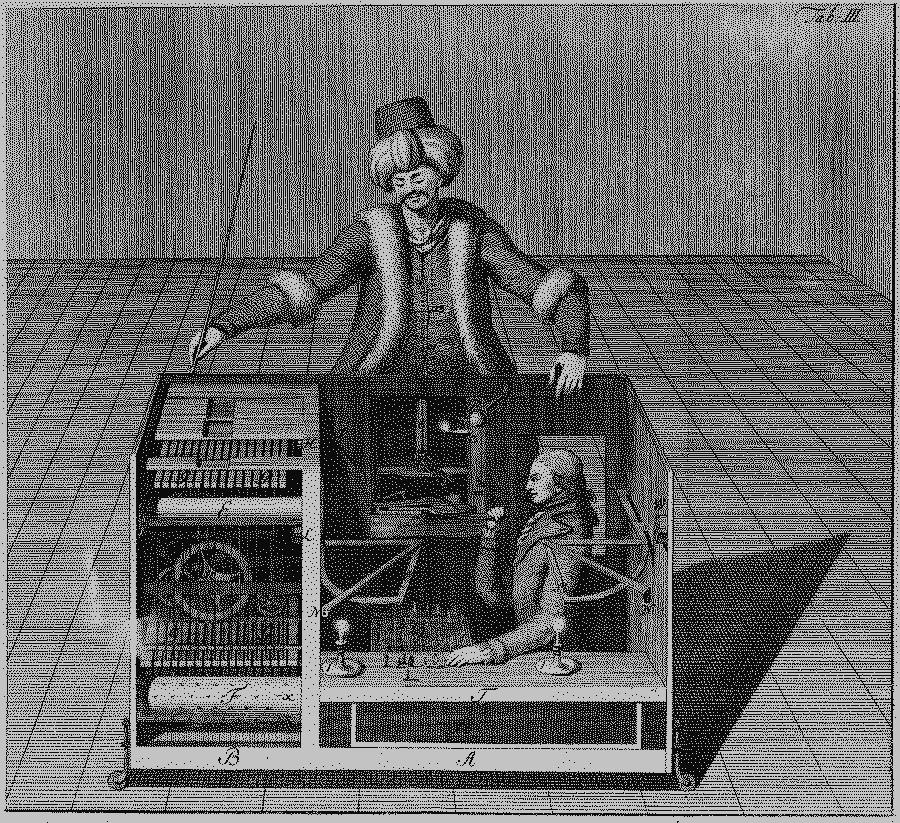
kempelen’s turk is the brazen head in reverse. the legend says a made thing held real knowledge. the turk claimed to be a made thing and held a real person.
what the stories keep
a few things recur across eight centuries of these accounts:
- the maker is a scholar, and usually a cleric
- the work takes years and is lost in an instant
- the head knows something its maker does not
- in malmesbury, the future
- in greene, only the time
- nobody is shown how it works
thomas hobbes turned the comparison around in 1651 and asked it of the body itself:
for what is the heart, but a spring; and the nerves, but so many strings; and the joynts, but so many wheeles, giving motion to the whole body, such as was intended by the artificer?5
the question was never really whether brass can speak. it was what we are doing when we build something in order to ask it, and whether we will be awake when it answers.
william of malmesbury, gesta regum anglorum, book ii, written about 1125. ↩︎
john gower, confessio amantis, book iv, about 1390. ↩︎
robert greene, the honorable historie of frier bacon and frier bongay, printed 1594. ↩︎
hero of alexandria, pneumatica, 1st century ce. ↩︎
thomas hobbes, leviathan, 1651, introduction. ↩︎